Showing posts with label Gulf oil spill. Show all posts

Wednesday, July 14, 2010

We practiced safe sex that was our practice

Why is the internet so great? Because the arts can keep up with current events, because there are journals that can publish things while they are still relevant.

From the July elimae, excerpts from Domefail by Patrick Lucy.
Members of congress began swimming down to inspect the oil leak for themselves this Tuesday. Aides to Senator John McCain, R-Az, credit the former presidential nominee with the idea, saying he "double-dared" Sen. John Barrasso, R-Wyo, to "touch the bottom."
"It's really a savvy political move," added one beltway pundit, "the American people want a proactive response, they want their reps to take action -- that's exactly what the republican delegation did during their visit. This wasn't just another political photo-op."
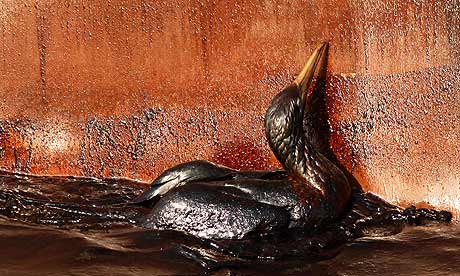
Upon returning to the surface, the delegation had to be scrubbed clean by volunteers from the Audubon Society before being released back to the senate. "The poor things," said one volunteer, "they struggled at first, but then their eyes just kind of rolled back into their heads and they relaxed. I think they knew we were trying to help them."
Plus more.

Thursday, July 8, 2010

If I delete this later it's because I used it in a project.


Independence Day in the Florida Keys coral reef system. All you can hear besides the motion of the water is the tiny crackling scratch of thousands of fish eating coral. If you look up from the sea floor, above the waterline, you will see twenty other tourists face-down in the water, invisible except for their snorkels and luminescent flotation devices, looking for all the world like giant fishing lures. Days before, NOAA reports a 61-80 percent chance of tar balls coming this way. There is a sense that one should be gobbling up as much of this experience as possible, in case it is the last chance.

Monday, June 28, 2010

There was a conversation I had with an Air Force sergeant who was in town with an F-16 demo team for the annual air show, which I was writing about for the paper. We were sitting around waiting for the show to get going, and conversation strayed into fuel consumption/costs/etc. I had no idea that airplanes burned so much. Especially stunt planes (he estimated 50-70 gallons/hour) and highly maneuverable fighter jets (up to 150 gallons/hour). I mentally stagger at the carbon footprint, he stays firmly in financial territory. “It’s all money spent in the defense of freedom.”

“So is the military looking into alternative fuels at all, given worries about supply?”
“Absolutely. There’s this process involving coal…”

Trying to stay neutral as possible, I wandered tentatively into BP territory: “It’s interesting, don’t you think, the extra attention it’s bringing to energy issues?” And he dismisses. “People forget that nearly everything they own is made from petroleum. Focus on fuel is short-sighted. Unless they find a way to make glass more cheaply, we’ll be using oil for a long time.” True, but it ignores the central question of what we CAN do, and the long-term concerns (opposing, in some ways, the short-term concerns of the military) that would make it worth pursuing.

It was an interesting anthropological moment. One of those where you say, Ah, the values here are very different, but they are held together by a certain kind of logic.

I went to that same air show “for fun” the next day. I have other thoughts, maybe for later, about air shows and America, the land where we go to events that boast about “turning fuel into fun,” the land where the deafening roar of a jet engine passing you at 650 mph is “the sound of freedom.”

Saturday, June 19, 2010

Oil boil toil trouble

Hey, so you know how the Gulf of Mexico is slowly turning into a wasteland, ja? Well, there have been a couple really good stories lately about the fact that spills like this have been happening in Nigeria's oil-producing regions for more than 50 years.

From the New York Times last week:
(By some estimates) The Niger Delta, where the wealth underground is out of all proportion with the poverty on the surface, has endured the equivalent of the Exxon Valdez spill every year for 50 years...
That's as much as 546 million gallons of oil. Shell, one of the companies which operates there, blames sabotage and theft. But:
Richard Steiner, a consultant on oil spills, concluded in a 2008 report that historically “the pipeline failure rate in Nigeria is many times that found elsewhere in the world,” and he noted that even Shell acknowledged “almost every year” a spill due to a corroded pipeline.
So it's not just BP (and for the last time, please stop calling it British Petroleum), and it's not just here. That doesn't make it less of a tragedy. But it's a reminder that rather than boycott BP (whose gasoline is actually sold everywhere, and who does not own most individual BP stations), the most important thing we can do is find ways to stop giving any oil companies our money. None of them is prepared to deal with major safety risks like deep-water drilling, and at least a few have proven themselves unwilling to deal with easily-fixed safety risks like a corroding pipe in an impoverished West African nation.

A good summary of Nigeria's oil issues:

Anup Shah, Nigeria and Oil, Global Issues, Updated: July 03, 2004

Tuesday, June 8, 2010

Space case

Today I've been thinking about

1. Baraboo schools
2. special education
3. oil
4. the Triangle Shirtwaist fire
5. the metaphorical capacity of phospholipids, back-to-back in neat rows to protect each other's hydrophobic tails from water. Though really fear has nothing to do with it, nor hostility. Just a lack of interest in / capacity for bonding with the surrounding water molecules.

Sunday, May 30, 2010

The Gulf of Mexico disaster as BP would like you to see it

It's very hard not to look at pictures from the Gulf of Mexico and feel like some flavor of "the end of the world as we know it" is approaching. The red muck on the open sea, the smoke and flames. The diagrams of enormous potential "plumes" suspended deep underwater, and all the maps of surface oil, like Rorschach blobs or tea leaves spelling out, at this point, a dismal but still unknowable future. The wetlands, already browning. The expected but haunting oiled birds, who are, for all their charismatic woe, still luckier than everything we can't scrub off one at a time because it is either too small, too fragile, or still an unknown problem.

If you go to BP's spill response website, though, it's easier to be cheerful!


Wow, look at all that scrubbing! I don't know what that white thing is or why it needs to be cleaned off, but those workers in their hazmat suits definitely look effective.

And look! BP is crunching a lot of data in a fancy war room! Surely they must know exactly what to do to fix everything, after crunching all of that data with their multiple flat-screened computer monitors.

BP doesn't tell us what is in those bags, but there are so many of them. And they look so clean and white! If they're full of oil, then surely that oil can't be so bad, either, because otherwise the bags would be all saggy and hydrocarbon-colored.


All this picture needs is a rainbow where that caution tape is. Look how blue that sky is. And we can't see much of the ocean, so it must be fine. There's some brown mucky stuff in the lower right, but those workers (again looking very efficient in their clean biohazard suits) who are probably actually displaced shrimp fishermen being paid far too little per day, will have that right-hand corner cleaned up in no time. There are so many of them, so just chill, everyone.

And if you read the short version of what they have to say about Operation Top Kill, you still have to wait until the very last clause of the very last sentence to understand that the operation failed. A very good use of inverted syntax, first taking you past all of the very good things they did in attempting this failed operation. The Columbia Journalism Review has a damning list of their other informational sins re: this disaster.

I'm just saying, thank thank thank thank somebody for journalists.